

Card Declined Abroad? How to Pay for Your Hotel Anyway

If your card is declined abroad at a hotel, the cause is usually one of three things: your bank has paused the card as a fraud check, a hotel hold has used up your available limit, or the card’s settings block overseas payments. You can fix most of these with a call or a few taps in your banking app. The safer move is to pay for the room before you travel, so a decline at the desk can’t cost you the stay.
This guide covers why it happens, what to do on the spot, how to prepare before your next trip, and how paying ahead with crypto takes the card out of the equation.
Why your card is declined abroad
There are three common reasons for a card declined abroad, and you can fix most with one call to your bank.
1. Your bank thinks it might be fraud
Banks watch for spending that doesn’t fit your usual pattern. A payment from a new country, at an unusual time or for a larger amount than normal can trigger an automatic block. The bank pauses the card until it can confirm the payment is yours. If it can’t reach you, for example because your phone is off or roaming isn’t on, the card stays blocked.
A hotel can make this worse by trying the same card several times in a row. Repeated attempts can look like someone testing a stolen card.
2. A hotel hold has used up your limit
Many hotels place a hold on your card when you book or check in. It covers the room and often extras such as minibar or damage. The hotel doesn’t take the money, but it reserves it, so your available credit or balance drops.
If you’re close to your limit, the next payment can fail even though you haven’t spent the money. Holds usually drop off once you pay the final bill on the same card. If you pay another way, a hold can take up to 15 days to clear, so ask the front desk to release it.
3. Your card isn’t set up for overseas payments
Some cards have overseas or online payments switched off by default as a safety feature. Others have a daily spending limit that a hotel bill can push you past. Debit cards in particular can hit a limit on large single payments.
Other causes are less common: an expired card, a replacement card you haven’t activated, or a card network the hotel doesn’t accept.
What to do if your card is declined abroad
Card declined abroad at the front desk? Work through these steps in order.
- Stay calm and ask what the error was: The front desk can often see whether the decline came from your bank or from the payment terminal.
- Check your banking app: Look for a fraud alert or a payment to approve. Many banks let you confirm a payment or unfreeze the card in the app.
- Call your bank: Use the number on the back of your card. Ask whether it’s a fraud block, a hold or a limit, since each has a different fix.
- Ask the hotel about holds: Find out how much they’ve reserved and whether they can lower or release it.
- Don’t let them retry over and over: Each failed attempt can deepen the fraud flag. Fix the cause first, then try once.
- Use your backup: A second card, or another way to pay, gets you checked in while you sort out the first.
How to stop your card being declined abroad
You can fix most causes of a card declined abroad before you leave home.
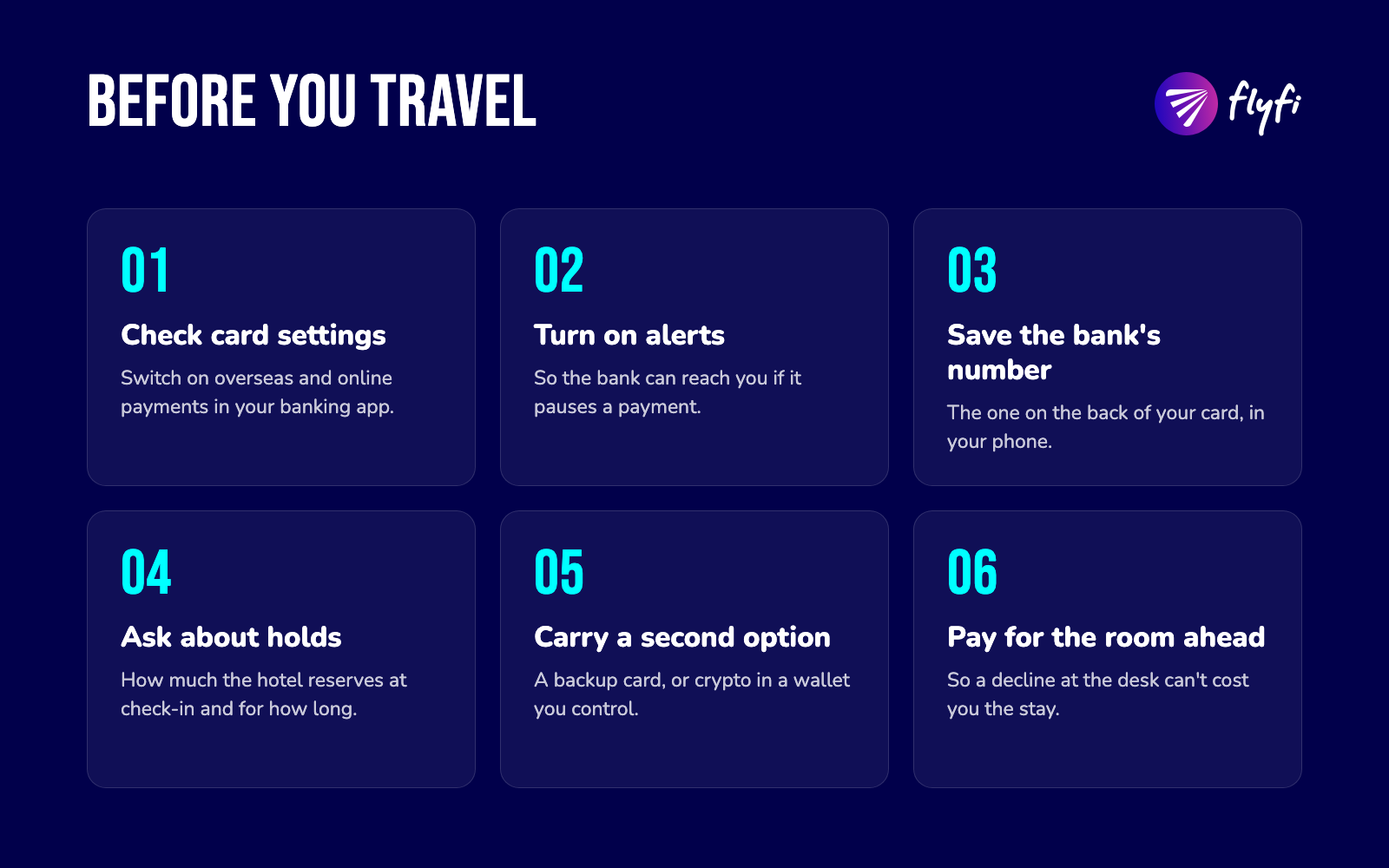
Many banks no longer need a travel notice, but some still use them, so check what yours says. For your backup, pick a card from a different bank or card network, so one block doesn’t stop both.
The last point on the list matters most. When you’ve paid for your stay up front, a card problem at check-in becomes an inconvenience, not a crisis.
Paying for your hotel before you travel
Booking and paying online before you go means a card declined abroad can’t touch the biggest payment of the trip. You pay from home, with your phone and your bank within reach.
On Flyfi, you can pay for your stay with crypto, including Bitcoin, Ethereum, Solana, USDT and USDC. At checkout you scan a QR code with any wallet that works with WalletConnect and pay within the 15-minute timer. There’s no bank in the middle to pause the payment, and no card limit for a hold to eat into.
Flyfi also accepts Visa and Mastercard, as long as every room in your booking includes free cancellation. Stablecoins track a currency such as the US dollar, so the amount stays predictable between booking and payment.
You don’t need an account to book, and you don’t need a bank account or an identity document to pay.
What to check before you pay with crypto
A few things to know before you pay:
- Pay before the timer runs out: Have your wallet open and funded before you reach checkout. A payment that arrives after the timer won’t go through. You’ll get an email explaining how to recover it, minus transaction fees.
- Leave room for the network fee: Keep a little extra in your wallet on top of the booking amount.
- Be sure of your dates: Look for the “Non-refundable” label before you pay. If you cancel a free-cancellation room in time, you get the full amount back to the wallet you paid from. Non-refundable rooms don’t get a refund, though in some cases Flyfi might be able to offer a coupon for the same dollar value.
- Bring ID and a card for check-in: You don’t need ID to pay, but the hotel will ask for it when you arrive, as hotels do everywhere. Many hotels also ask for a card as a deposit to cover extras, so keep one that works abroad.
For more on why crypto payments still lean on banks in other parts of the journey, read Most Crypto Payments Still Depend on the Banking System. And if you’ve ever felt like a suspect at checkout, Why Travel Websites Still Treat Users Like They’re Suspicious explains where those checks come from.
FAQ
Why is my card declined abroad when it works at home?
A card declined abroad is usually down to your bank’s fraud checks, which see a payment from a new location and pause the card until they can confirm it’s you. Card settings that block overseas payments and hotel holds are the other common causes.
How long does a hotel hold stay on my card?
It depends on the hotel and your bank. A hold usually clears once you pay the final bill on the same card. If you pay another way, it can stay for up to 15 days unless the hotel releases it.
Do I still need to tell my bank I’m travelling?
Many banks no longer ask for travel notices, but some still use them. Check with your bank, and make sure your contact details and alerts are up to date either way.
Can I pay for a hotel without a card?
Yes. On Flyfi you can pay for your stay with crypto, including Bitcoin, Ethereum, Solana, USDT and USDC, by scanning a QR code with your wallet at checkout.
Travelling soon? Book and pay for your stay on Flyfi before you leave.
Popular Posts

Overcoming Crypto Myths: Security and Volatility Debunked
Crypto myths persist despite 560 million global users in 2025, a 9.9% adoption rate driven by practical utility in payments and finance. Security fears stem from high-profile hacks, while volatility concerns overlook maturing markets and stablecoins. As crypto integrates into retail, remittances, and daily transactions, debunking these is key. This post examines evidence from 2025 […]

Case Studies: Real-World Crypto Use in Retail and Remittances
Crypto’s real-world utility shines in retail and remittances, where blockchain enhances efficiency beyond speculation. With 560M users in 2025 (9.9% global adoption), these sectors leverage crypto for lower costs, transparency, and speed. Retail adopts for supply chains; remittances for cross-border flows. This post examines case studies, showing crypto’s normalization in daily economics – excluding travel, […]

The Evolution of Payments: From Cash to Crypto
Payments have transformed from simple exchanges to sophisticated digital systems, mirroring societal and technological progress. In 2025, with global crypto adoption at 9.9% (560M users) and cashless transactions surging, this evolution underscores efficiency, inclusion, and innovation. From ancient barter to blockchain, payments now enable borderless, instant transfers—making crypto as natural as fiat. This post charts […]

Privacy in the Digital Age: Why It’s Essential Beyond Travel
In 2025, digital privacy isn’t a luxury – it’s a necessity. As our lives intertwine with technology, from smart homes to AI assistants, personal data flows endlessly. While platforms like Flyfi prioritize privacy in travel, the need extends far beyond booking trips. Data breaches expose billions, eroding trust and freedoms. Global adoption of privacy tools […]

Introduction to Crypto Travel: Why Pay with Digital Currencies?
What is crypto travel? Crypto travel involves using digital currencies like Bitcoin or Ethereum to book flights, hotels, and experiences seamlessly, just like using fiat money. In 2025, with 559 million global users, it’s a natural, borderless option avoiding conversions and enhancing privacy. In the fast-evolving world of travel and finance, crypto travel is emerging […]
Recent Posts

Crypto Hotel Booking: How It Works and What It Costs
A crypto hotel booking takes minutes: pick a room, scan a QR code, pay within 15 minutes. Here’s how it works and which fees you pay.

Can You Pay for a Hotel with Bitcoin?
Yes, you can pay for a hotel with Bitcoin. Pick your room on Flyfi, scan the QR code with your wallet and pay within the 15-minute checkout timer.

Blockchain Life Week 2026: A Dubai City Guide
Blockchain Life 2026 runs 1–2 December at Festival Arena, Dubai, with side events from 27 November. Where to stay, getting around and the week at a glance.

How to Book a Hotel with Crypto: A Step-by-Step Guide
Book a hotel with crypto in a few steps: choose your room and coin, scan the QR code with your wallet, and pay within 15 minutes.